Nomad eSIM
News
UK Travel Trends Statistics 2026
The key travel trends shaping where, how and why Brits travel in 2026.
UK residents spent £78.6 billion on trips abroad in 2024, the most recent full year of official data, and early 2026 traffic figures point to another record year for British travel. From staycations to long-haul getaways, the numbers show a nation that is booking earlier, spending more per trip and beginning to lean on mobile apps and AI tools to plan its holidays. This article pulls together the latest figures on outbound, inbound and domestic travel, covering booking habits, budgets, sustainability, consumer protection and where Britons are actually going in 2026.
Report Highlights
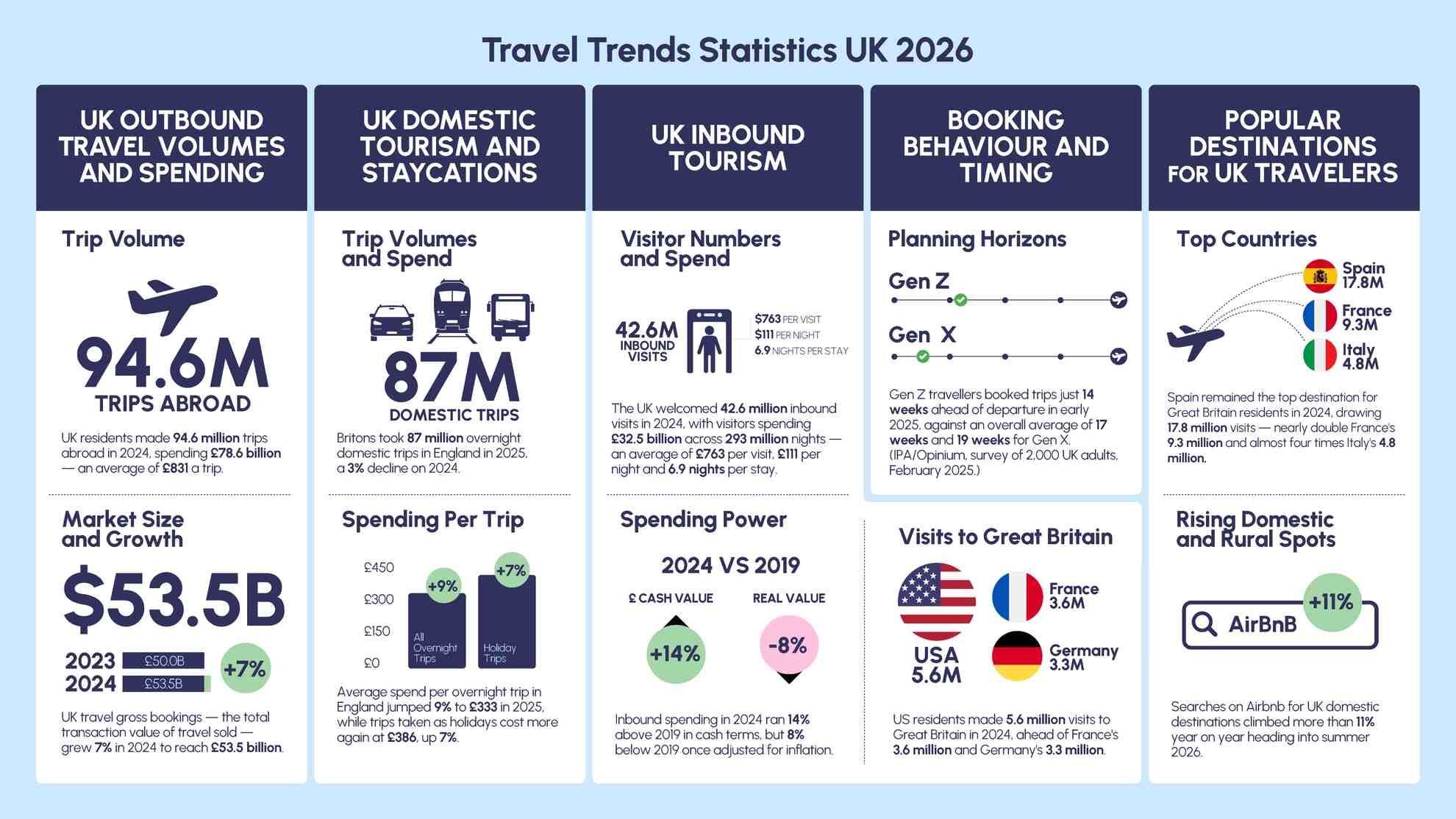
- UK residents made 94.6 million trips abroad in 2024, spending £78.6 billion — an average of £831 a trip.
- In 2024, 50% of holidaymakers booked four months or more ahead of travel, and just 15% within a month.
- Domestic tourism spending in England rose 3% to £78 billion in 2025.
- 88% of UK travel bookings by value were made online in 2024, on track to reach 90% by 2027.
- 75% of UK adults say they are concerned about climate change; 38% say they would pay more to cut their flight's emissions.
- UK airports carried 61 million passengers in Q1 2026, 1 million more than Q1 2025 and a record for the period.
- Inbound visitor spending is forecast to reach £35.7 billion in 2026, up 7% on 2025 in cash terms.
- 47% of 18 to 34-year-olds say they plan to fly more in 2026, versus 22% of over-55s.
UK Outbound Travel Volumes and Spending


Outbound travel has climbed back to near-record volumes, with British travellers taking more trips and spending more per trip than at any point since the pandemic. The figures below cover how often UK residents went abroad, what they spent and how fast the booking market is growing.
How much UK residents travelled abroad Trip volumes and holiday-taking both rose in the most recent full year of data, though people are spreading their travel across slightly fewer breaks.
- In 2024, UK residents made 94.6 million visits abroad and spent £78.6 billion. That works out at £831 per visit across all trip types — a figure derived from the two ONS totals rather than published by the ONS.
- In the year to July 2025, 87% of people took a holiday, up 3 percentage points and the highest share since 2019, though the average number of holidays per person dipped to 3.8 from 3.9. (ABTA consumer research.)
- Package holidays remained the most popular format in the year to July 2025, booked by 54% of all travellers, up from 52% the year before. (ABTA consumer research.)
Market size and growth Transaction values are climbing faster than trip volumes, pointing to higher prices and higher-value bookings rather than simply more travel.
- UK travel gross bookings — the total transaction value of travel sold — grew 7% in 2024 to reach £53.5 billion.
- Outbound travel's gross value added to the UK economy is projected to rise from £52 billion to £62 billion by 2030, growth of about 19%.
UK Domestic Tourism and Staycations Domestic travel moved in two directions during 2025, with overnight trips falling while day visits and spending per trip both rose. All figures in this section cover England only, and are drawn from the Great Britain Tourism Survey.
Trip volumes and spend
Volumes and value pulled apart, as fewer overnight trips still generated more money.
Britons took 87 million overnight domestic trips in England in 2025, a 3% decline on 2024.
Day trips in England proved more resilient, climbing 2% to 928 million visits in 2025.
Domestic tourism spending in England rose 3% to £78 billion in 2025, split between £29 billion on overnight stays, up 6%, and £49 billion on day visits, up 1%. (The component figures are rounded to whole billions; the underlying rise is a little under 3%.)
Spending per trip Per-trip spending rose far faster than trip numbers, and trips taken specifically as holidays cost noticeably more than the overnight average.
- Average spend per overnight trip in England jumped 9% to £333 in 2025, while trips taken as holidays cost more again at £386, up 7%.
- Day-trip spending in England held steady at £53 per visit, down just 1% on 2024.
Where people went Cities gained share at the expense of traditional coastal and rural regions.
- Large towns and cities captured 51% of overnight domestic trips in England in 2025, up from 46% in 2024.
- The South West's share of England's overnight trips slipped to 15% in 2025, down from 18% in 2022–23.
UK Inbound Tourism
Inbound visitor numbers have almost returned to pre-pandemic levels, but the value of that spending looks very different once inflation is stripped out. The comparisons below are as published by VisitBritain.
Visitor numbers and spend
- The UK welcomed 42.6 million inbound visits in 2024, with visitors spending £32.5 billion across 293 million nights — an average of £763 per visit, £111 per night and 6.9 nights per stay.
- Inbound visits to the UK in 2024 sat 1% below pre-pandemic 2019 levels but 6% above 2023.
Spending power Cash-terms growth and inflation-adjusted growth tell opposite stories, which matters for anyone reading these totals as a recovery signal.
- Inbound spending in 2024 ran 14% above 2019 in cash terms, but 8% below 2019 once adjusted for inflation.
- Against 2023, inbound spending rose 5% in cash terms and 2% in real terms.
Who's visiting North America remains the single largest source of visits, well ahead of the nearest European markets.
- US residents made 5.6 million visits to Great Britain in 2024, ahead of France's 3.6 million and Germany's 3.3 million.
Booking Behaviour and Timing
Lead times and research habits shifted through 2025, with younger travellers behaving very differently from older ones. All figures in this section come from consumer surveys of stated behaviour.
Planning horizons Most people commit months ahead of departure, but the gap between generations is wide.
- Gen Z travellers booked trips just 14 weeks ahead of departure in early 2025, against an overall average of 17 weeks and 19 weeks for Gen X. (IPA/Opinium, survey of 2,000 UK adults, February 2025.)
- Holidaymakers spent an average of 3.8 weeks researching a trip before booking, rising to 4.3 weeks among Gen Z. (IPA/Opinium, February 2025.)
- In 2024, 50% of holidaymakers booked four months or more before travel, while just 15% booked within a month of departure. (YouGov, survey of 2,010 UK adults, September 2024.)
Popular Destinations for UK Travellers
Spain still dominates British outbound travel, while search data points to growing interest in rural England and short-haul European spots.
Top countries The top three outbound destinations have not changed, and the gap between first and second remains wide.
- Spain remained the top destination for Great Britain residents in 2024, drawing 17.8 million visits — nearly double France's 9.3 million and almost four times Italy's 4.8 million.
Rising domestic and rural spots The figures below measure search interest on Airbnb, not trips taken. They indicate where attention is growing rather than where people ultimately went.
- Searches on Airbnb for UK domestic destinations climbed more than 11% year on year heading into summer 2026.
- Herefordshire led the rural search growth, up 76%, followed by Staffordshire at 50% and Worcestershire at 48%.
- Among city-fringe destinations, Richmond upon Thames saw the sharpest search growth, up 140%, ahead of Milton Keynes at 96% and Stirling at 79%.
Emerging international hotspots Again, these are Airbnb search figures rather than measured travel volumes.
- Novalja in Croatia recorded a 273% jump in Airbnb search interest, while Himarë in Albania rose 92%.
- All 10 of Airbnb's trending international destinations for UK travellers sat within Europe, with the average booked international trip covering 317 miles against a European average of 419 miles.
Travel Spending and Budgets
Holiday budgets rose sharply for 2025, with the gap between an overseas trip and a UK break running into thousands of pounds. The budget figures below are stated intentions from commissioned surveys, not recorded spending, which is why they sit well above the £831 average spend per visit in the ONS data — they cover full holidays rather than every category of trip including short and business travel.
Trip budgets
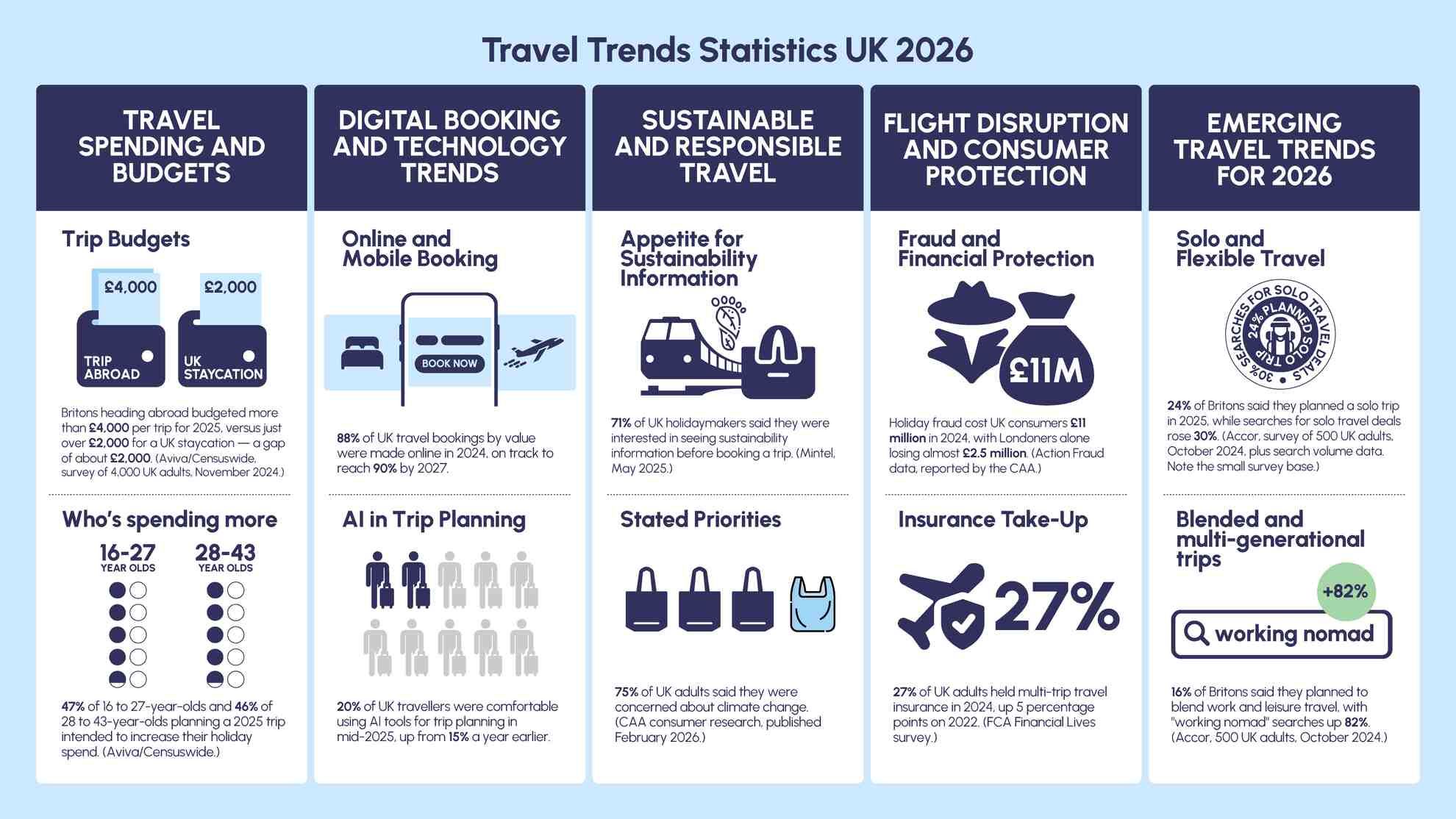
- Britons heading abroad budgeted more than £4,000 per trip for 2025, versus just over £2,000 for a UK staycation — a gap of about £2,000. (Aviva/Censuswide, survey of 4,000 UK adults, November 2024.)
- 41% of holidaymakers planned to spend more in 2025, raising their planned budgets by an average of £2,982 per trip on the previous year. (Aviva/Censuswide.)
- Among those planning to spend more, 14% set aside over £5,000 per trip and 2% planned to spend more than £20,000. (Aviva/Censuswide.)
Who's spending more Younger travellers drove almost all of the increase in planned spending.
- 47% of 16 to 27-year-olds and 46% of 28 to 43-year-olds planning a 2025 trip intended to increase their holiday spend. (Aviva/Censuswide.)
Cost of living on the ground In-resort costs varied widely between destinations.
- The Algarve was the cheapest destination surveyed in 2025, with a three-course meal for two with wine at £40.33 and an eight-item tourist basket at £58.95. (Post Office Travel Money.)
- New York was the priciest, with the same eight-item basket rising 15.6% to £167.85 — nearly three times the Algarve's total. (Post Office Travel Money.)
Digital Booking and Technology Trends
Almost all UK travel is now booked online by value, and mobile is close to overtaking desktop. AI has arrived in trip planning but adoption remains limited.
Online and mobile booking Online penetration is close to saturation, so the remaining change is about device rather than channel. Both figures below are shares of gross booking value, not of trips taken.
- 88% of UK travel bookings by value were made online in 2024, on track to reach 90% by 2027.
- Mobile devices accounted for 46% of online gross travel bookings in 2024 and were expected to overtake desktop by 2026, with tablet counted separately.
AI in trip planning Comfort with AI trip planning is rising from a low base, and outright resistance still outweighs enthusiasm. All three figures are stated attitudes from a YouGov survey of UK travellers, July 2025.
- 20% of UK travellers were comfortable using AI tools for trip planning in mid-2025, up from 15% a year earlier.
- 26% of travellers had used or would use AI for translation and local communication abroad.
- 31% would rather not use AI at all when planning a trip, outnumbering the 20% who were comfortable with it.
Sustainable and Responsible Travel
Britons say they want sustainability information, but far fewer say they would pay for lower-emission travel. Every figure in this section is stated attitude from a survey, not measured behaviour.
Appetite for sustainability information
- 71% of UK holidaymakers said they were interested in seeing sustainability information before booking a trip. (Mintel, May 2025.)
Where stated priorities sit Two separate surveys, a year apart, point in the same direction — concern is widespread, willingness to pay is not. They are not two halves of one finding.
- 75% of UK adults said they were concerned about climate change. (CAA consumer research, published February 2026.)
- 38% said they would be willing to pay more to reduce the carbon emissions produced by their flight. (Ipsos UK for the Royal Aeronautical Society, fieldwork December 2024.)
Flight Disruption and Consumer Protection
Holiday fraud losses ran into the millions in 2024 while the package travel protection fund covered tens of millions of bookings.
Fraud and financial protection
- Holiday fraud cost UK consumers £11 million in 2024, with Londoners alone losing almost £2.5 million. (Action Fraud data, reported by the CAA.)
- Financial protection for package holidays covered 30.1 million passenger bookings in the year to March 2024, funded by £2.50 per passenger and totalling £75,369,299.
- Six travel firm failures in that year cost the protection fund an expected £3,985,364 — an average of £664,000 per failure — down from eight failures costing £5,306,040 the year before.
Insurance take-up Travel insurance holding grew between 2022 and 2024.
- 27% of UK adults held multi-trip travel insurance in 2024, up 5 percentage points on 2022. (FCA Financial Lives survey.)
- 23% held single-trip cover in 2024, up 9 percentage points over the same period. (FCA Financial Lives survey.)
Emerging Travel Trends for 2026
Solo trips, work-and-leisure blends and multi-generational holidays are all growing, while cost remains the main barrier. The figures below are drawn from commissioned surveys and search data unless stated otherwise.
Solo and flexible travel
- 24% of Britons said they planned a solo trip in 2025, while searches for solo travel deals rose 30%. (Accor, survey of 500 UK adults, October 2024, plus search volume data. Note the small survey base.)
Blended and multi-generational trips
- 16% of Britons said they planned to blend work and leisure travel, with "working nomad" searches up 82%. (Accor, 500 UK adults, October 2024.)
- 51% of Gen Z said they would rather cruise with their parents, compared with just 20% of Gen X. (Survey commissioned by Marella Cruises, part of TUI Group — a cruise operator measuring appetite for cruising.)
- 60% of UK parents said they actively choose holidays based on their child's needs and interests. (Hilton/OnePoll, survey of 2,000 UK adults, September 2024.)
Practical barriers and paperwork Cost is the main thing keeping people on the ground, while passport processing has moved almost entirely online.
- UK passport applications reached 7,816,279 in 2024, with 7,451,487 — 95.3% — submitted online. (HM Passport Office.)
- 36% of non-flyers cited financial limitations as the main reason they had not flown in the past year. (CAA UK Aviation Consumer Survey, February 2026.)
2026 Outlook
Forecasts point to record inbound volumes and continued outbound growth in 2026, though real-terms spending still trails pre-pandemic levels and UK sector growth lags the global rate.
Inbound tourism forecasts Currency warning: this forecast was published in February 2026. VisitBritain noted in April 2026 that bookings had tracked below the previous year since February and that a downward revision at the mid-year update was "very likely". Check for a revised forecast before relying on these figures.
- Inbound visits are forecast to reach 45.5 million in 2026, generating £35.7 billion in visitor spending — around £785 per visit.
- That represents 4% growth in visits and 7% growth in nominal spend on 2025, or 5% once adjusted for inflation.
- 2026 visits would reach 105% of 2019 levels and nominal spend 126%, though real spend stays at just 96% of pre-pandemic levels — meaning inflation-adjusted inbound spending will still not have recovered seven years on.
- European inbound markets are forecast to grow 4% by volume and 6% by value, while long-haul markets grow faster at 5% and 8%.
Outbound intentions Stated flying intent is up overall, and the increase is concentrated among younger travellers. These are survey intentions, not bookings.
- 31% of consumers said they plan to fly more in 2026, building on the 62% who flew in the previous 12 months. (CAA UK Aviation Consumer Survey, February 2026.)
- 47% of 18 to 34-year-olds said they plan to fly more in 2026, more than double the 22% of over-55s and ahead of the 29% of 35 to 54-year-olds. (CAA UK Aviation Consumer Survey.)
Aviation and passenger records Early 2026 traffic set a record for the period, with the strongest growth on Spanish routes.
- UK airports carried more than 61 million passengers in the first quarter of 2026, a record for that period and 1 million more than Q1 2025.
- Passenger traffic to Madrid rose 14% in the first quarter of 2026, and to Las Palmas by 11%.
- UK airport passenger numbers are forecast to reach 491 million by 2050 under the Department for Transport's central scenario, within a range of 412 million to 510 million.
Growth pressures UK sector growth is running behind the global rate.
- UK travel and tourism GDP growth was expected to reach 4.3% in 2025 against a global rate of 6.7% — a gap of 2.4 percentage points, leaving the UK growing at roughly two-thirds the global pace.
Sources
- Office for National Statistics — Travel trends: 2024, August 2025. https://www.ons.gov.uk/peoplepopulationandcommunity/leisureandtourism/articles/traveltrends/2024
- Phocuswright — UK Travel Market Sees Mobile Acceleration and a Shifting Infrastructure Landscape, May 2025. https://www.phocuswright.com/Travel-Research/Research-Updates/2025/uk-travel-market-sees-mobile-acceleration-and-a-shifting-infrastructure-landscape
- ABTA — Holiday Habits 2025/26, October 2025. https://www.abta.com/sites/default/files/media/document/uploads/Holiday%20Habits_2025_26_FINAL.pdf
- ABTA — Economic growth is there for the taking if the outbound travel industry is supported by government, 11 June 2025. https://www.abta.com/news/economic-growth-there-taking-if-outbound-travel-industry-supported-government
- VisitBritain — Domestic tourism: latest annual results (England, 2025 data). Rolling page, overwritten annually. https://www.visitbritain.org/research-insights/domestic-tourism-latest-annual-results
- VisitBritain — Inbound visits and spend: annual UK results (2024 data), August 2025. https://www.visitbritain.org/research-insights/inbound-visits-and-spend-annual-uk
- IPA, survey by Opinium — Holiday Booking Plans 2025, February 2025 (n=2,000 UK adults). https://ipa.co.uk/news/holiday-booking-plans-2025
- YouGov — Travel booking trends: how far in advance do Brits plan?, September 2024 (n=2,010 UK adults). https://business.yougov.com/content/50712-travel-booking-trends-how-far-in-advance-do-brits-plan
- Aviva, survey by Censuswide — Four in 10 UK holidaymakers to boost 2025 travel budgets, March 2025 (n=4,000 UK adults, fieldwork 8–15 November 2024). https://www.aviva.com/newsroom/news-releases/2025/03/four-in-10-uk-holidaymakers-to-boost-2025-travel-budgets/
- Post Office Travel Money — Holiday Money Report, 2025. https://www.postoffice.co.uk/travel-money/guides/holiday-money-report
- YouGov — Brits more comfortable using AI for trip planning than last year, July 2025 (n=1,635 UK travellers). https://yougov.com/en-us/articles/52771-brits-more-comfortable-using-ai-for-trip-planning-than-last-year
- Mintel — UK Sustainability in Travel Market Report, 15 May 2025. https://store.mintel.com/report/uk-sustainability-in-travel-market-report
- Ipsos UK for the Royal Aeronautical Society — flight emissions attitudes survey, fieldwork 13–17 December 2024, published April 2025 (n=2,000+ UK adults aged 16–75). https://www.ipsos.com/en-uk/38-say-they-would-be-willing-pay-more-reduce-their-carbon-emissions-produced-their-flight
- Accor — Travel Trends 2025, November 2024 (n=500 UK adults, fieldwork October 2024, plus Google Keyword Planner data). https://all.accor.com/a/en/limitless/thematics/lifestyle-trends/travel-trends-2025.html
- UK Civil Aviation Authority — New CAA data suggests 2026 will be another year of growth for the aviation sector, 9 February 2026, reporting the UK Aviation Consumer Survey (CAP3213). https://www.caa.co.uk/newsroom/news/new-caa-data-suggests-2026-will-be-another-year-of-growth-for-the-aviation-sector/
- Action Fraud data reported by the UK Civil Aviation Authority — Black Friday warning issued as £11 million lost to holiday fraud last year, 28 November 2025. https://www.caa.co.uk/newsroom/news/black-friday-warning-issued-as-11-million-lost-to-holiday-fraud-last-year/
- Air Travel Trust — Report and Financial Statements for the year ended 31 March 2024, published 25 July 2024. https://www.caa.co.uk/data-and-publications/publications/documents/atol/att-report-2024/
- Financial Conduct Authority — Financial Lives 2024 survey: General insurance and protection, May 2025. https://www.fca.org.uk/publication/financial-lives/fls-2024-general-insurance-protection.pdf
- Hilton, UK survey by OnePoll — 2025 Trends Report, 2025 (n=2,000 UK adults, fieldwork 2–4 September 2024). https://stories.hilton.com/emea/releases/2025-travel-trends-uk-eng
- Marella Cruises / TUI Group — multi-generational cruise survey, October 2025. https://www.tuigroup.com/en/newsroom/news/3-in-5-brits-would-pick-a-multi-generational-cruise-holiday-according-to-marella-cruises-survey-results
- HM Passport Office data obtained by MoneySavingExpert under FOI, April 2025. https://www.moneysavingexpert.com/news/2025/04/passport-application-fee-savings-online-paper/
- UK Civil Aviation Authority — UK aviation sees strongest start to the year as passenger numbers hit record high, 27 May 2026. https://www.caa.co.uk/newsroom/news/uk-aviation-sees-strongest-start-to-the-year-as-passenger-numbers-hit-record-high/
- World Travel & Tourism Council — WTTC warns that new UK tourism levies would dent growth, restrict jobs and reduce competitiveness, February 2026. https://wttc.org/news/wttc-warns-that-new-uk-tourism-levies-would-dent-growth,-restrict-jobs-and-reduce-competitiveness
- Department for Transport — UK aviation forecast 2026, 18 June 2026. https://www.gov.uk/government/publications/uk-aviation-forecast-2026
- Airbnb — Summer Travel Trend Forecast: Where Brits are really going this summer, May 2026. Rolling page, reused annually. https://news.airbnb.com/en-uk/summertraveltrends/
- VisitBritain — Inbound tourism forecast (2026 forecast, published February 2026, revision expected). Rolling page. https://www.visitbritain.org/research-insights/inbound-tourism-forecast