Nomad eSIM
News
Brits Are Wasting Time on Flight Booking Myths
Nomad dug into leading travel platforms, aviation data, and expert insight — here's what the numbers actually say


Clearing your cookies, browsing in Incognito Mode and waiting until Tuesday to book flights are among the biggest myths still influencing British travellers, according to new analysis from Nomad eSIM.
As millions of Brits prepare for their summer holidays, new analysis by Nomad eSIM reveals that many of the internet's most popular flight booking "hacks" are unlikely to save travellers money, despite continuing to circulate widely online.
The research comes as airline pricing faces increasing scrutiny and airfares become more volatile due to rising passenger demand, fluctuating fuel costs and dynamic pricing systems. According to the UK Civil Aviation Authority, UK airports welcomed around one million more passengers in the first quarter of 2026 than during the same period last year, while the International Air Transport Association (IATA) expects airlines' fuel bills to rise significantly this year as jet fuel prices remain elevated.
To help travellers separate fact from fiction, Nomad eSIM analysed guidance from leading travel platforms, aviation experts and official industry data to rank the UK's most common flight booking hacks based on the available evidence.

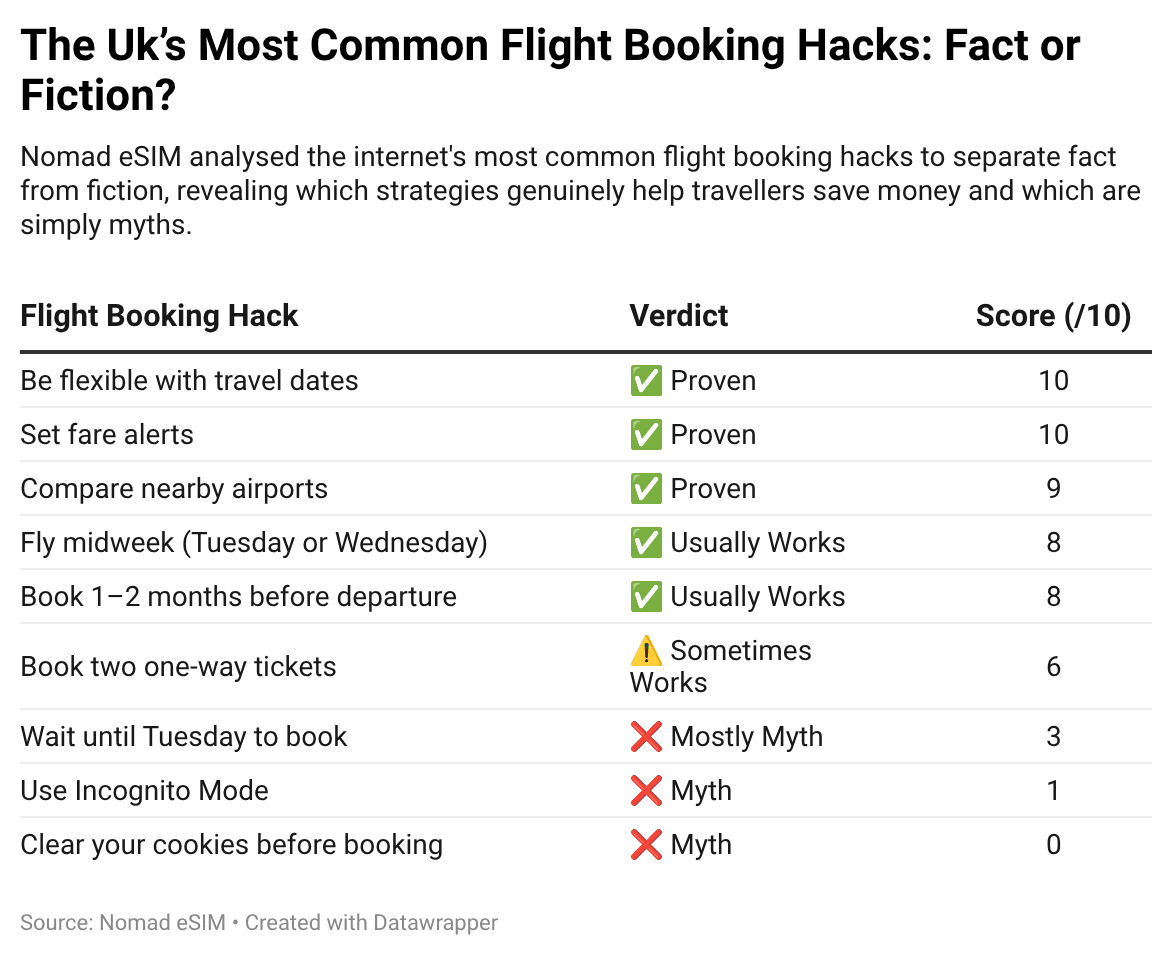
While many travellers still believe airlines increase prices based on repeated searches or browser history, travel platforms including Google Flights, Skyscanner and Going state there is little evidence that clearing cookies or browsing privately leads to cheaper fares. Instead, prices are primarily influenced by seat availability, demand, competition on individual routes, seasonality and airline pricing algorithms.
Meanwhile, strategies such as tracking fares, remaining flexible with travel dates and comparing alternative airports continue to be among the most effective ways to reduce flight costs.
Our Data Shows There Is No Single “Best Time” to Book
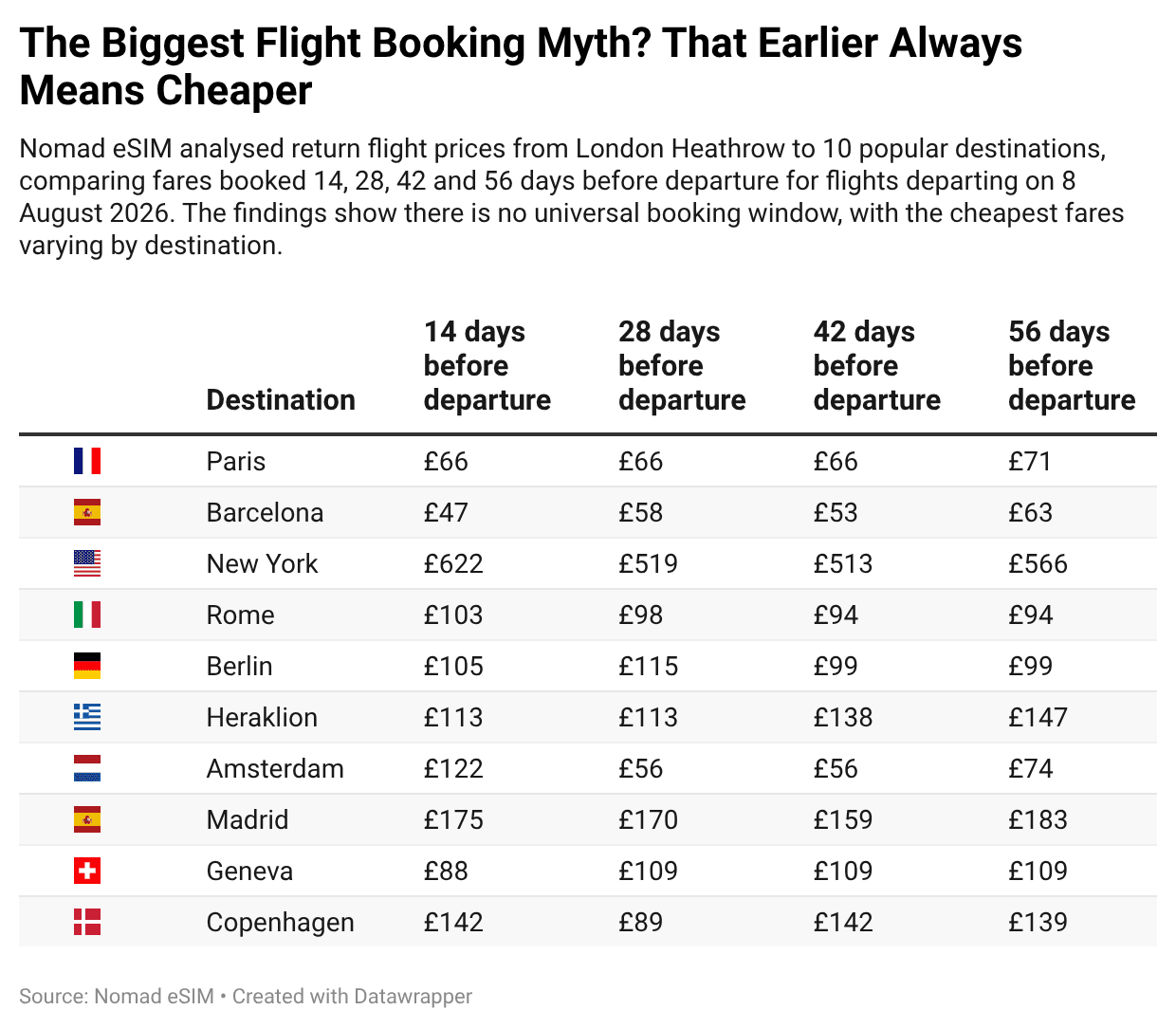
To test one of the most common pieces of booking advice, we tracked return flight prices from London Heathrow to ten popular destinations, comparing fares booked 14, 28, 42 and 56 days before departure for flights leaving on 8 August.
The results showed there is no universal rule that booking earlier always guarantees the cheapest fare. While some destinations became cheaper the further in advance travellers booked, others were cheapest just two weeks before departure.
For example:
- New York was cheapest when booked 42 days in advance (£513), compared with £688 just 14 days before departure, a saving of £175 (25%).
- Berlin also rewarded early booking, falling from £130 at 14 days to £99 when booked 42 or 56 days ahead.
- However, Heraklion was cheapest 14 or 28 days before departure (£113), before rising again to £138 at 42 days and £147 at 56 days.
- Barcelona was actually cheapest 14 days before departure (£47), compared with £63 when booked 56 days in advance.
- Paris showed almost no variation at all, remaining between £66 and £71 regardless of when the ticket was purchased.
Overall, the findings suggest travellers should avoid relying on a fixed booking window. Instead, using fare alerts, comparing prices over time and remaining flexible with travel dates are far more reliable ways to find cheaper flights than following one-size-fits-all booking advice.

Why Flight Prices Feel More Unpredictable Than Ever
Several factors are making airfare pricing increasingly dynamic, including:
- Higher passenger demand across UK airports
- Rising aviation fuel costs
- Seasonal travel peaks
- Real-time seat availability
- Competition between airlines
- Dynamic pricing systems that respond to changing demand
Together, these factors mean ticket prices can change multiple times a day, creating the impression that airlines are targeting individual customers when, in reality, pricing is largely driven by market conditions.
Shern Ng, General Manager at Nomad eSIM, said:
"Travellers have never had access to more information, yet many are still relying on outdated advice when booking flights. Hacks like clearing cookies or using Incognito Mode have become widely accepted online, but they can distract people from the strategies that genuinely make a difference.
The biggest savings usually come from staying flexible, setting fare alerts and planning ahead rather than trying to outsmart airline pricing algorithms. As travel becomes increasingly data-driven, giving travellers trustworthy, evidence-based advice is more valuable than ever.
At Nomad, we want people to get more with every trip, from discovering new places to embracing spontaneous moments. That's why we're focused on making every stage of the journey simpler. Wherever your travels take you, staying connected should be one thing you never have to second guess."
Methodology
Nomad eSIM reviewed publicly available guidance, official aviation statistics and travel platform insights to assess the evidence behind the UK's most common flight booking hacks. Each hack was categorised as "Proven", "Often Effective", "Can Work", "Mostly Outdated" or "Myth" based on the weight of available evidence.