Nomad eSIM
News
The World’s Most Popular Food Capitals, Ranked
Nomad eSIM analysed 40 cities around the world on which destinations offer the strongest overall food experience

Every year, millions of people plan entire holidays around food. Whether it is tasting authentic street food, eating at Michelin-starred restaurants or discovering local specialities, a city’s culinary reputation can play a major role in where travellers choose to go.
But which destinations offer the strongest overall food experience? To find out, Nomad eSIM analysed 40 cities around the world using six measures:
- global search demand for food-related queries,
- Instagram and TikTok hashtag volumes for food-related terms in each city
- restaurant density,
- Michelin Guide presence,
- meal affordability and
- the diversity of cuisines available. Relevant figures were adjusted per 100,000 residents, allowing smaller destinations to compete fairly with some of the world’s largest metropolitan areas.

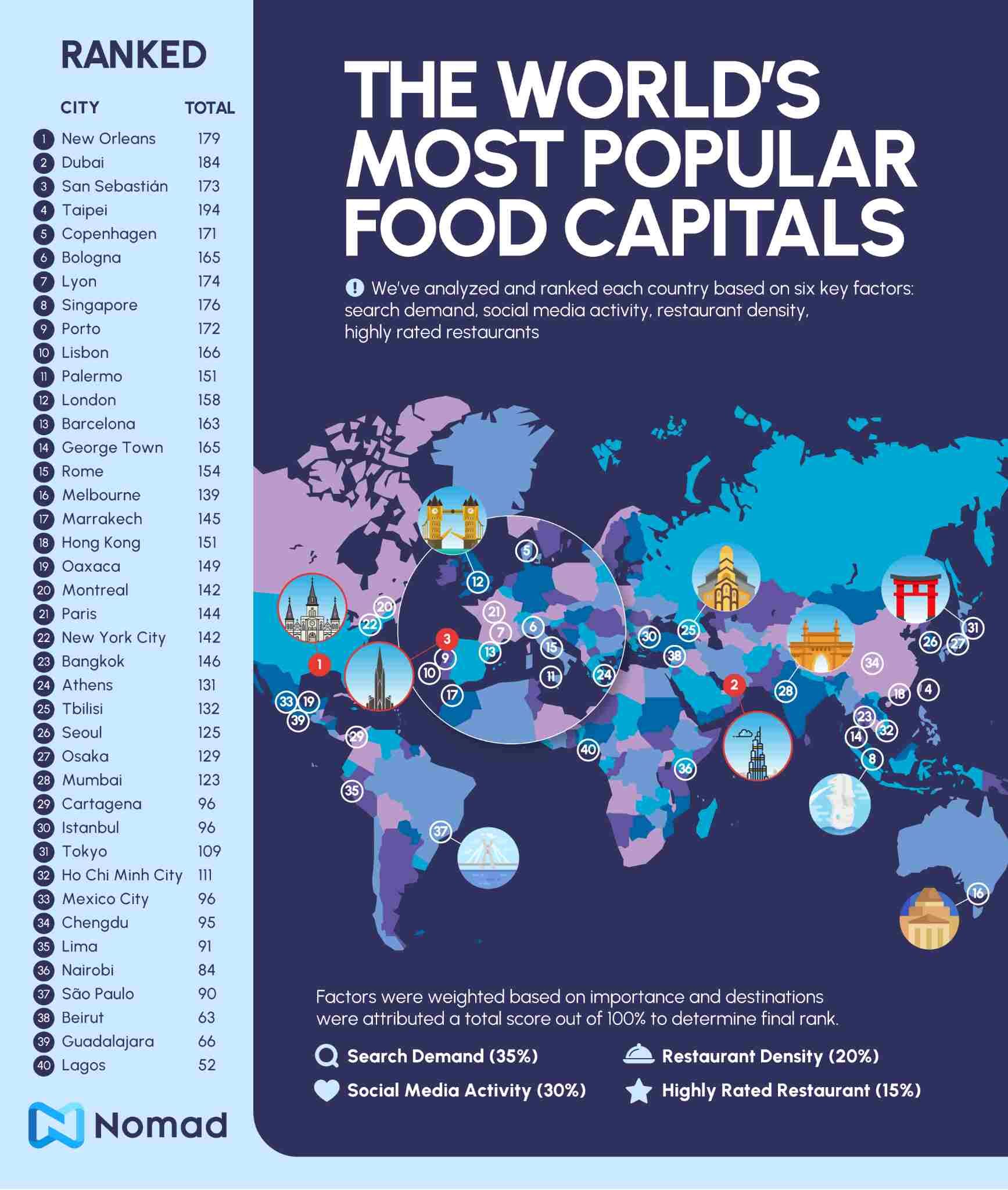
The Top 3 Food Cities in the World
1. New Orleans, USA — 33.7/40
New Orleans takes first place thanks to an exceptional combination of global interest, social media popularity, restaurant density and one of the world’s most recognisable food cultures.
Why it ranked here:
- Highest search demand score in the study, at 40/40
- Highest social media score per capita, generating more than 137,000 food-related Instagram and TikTok posts per 100,000 residents
- Second-highest restaurant density score, at 39/40
- Strong Michelin presence, scoring 38/40
- Famous worldwide for dishes including gumbo, jambalaya, po’boys and beignets
The downside:
- Dining is relatively expensive, receiving just 2/40 for affordability
- The city’s popularity means many of its best restaurants require reservations well in advance
2. Dubai, UAE — 32.2/40
Dubai ranks second due to its strong social media engagement, exceptional cuisine diversity and extensive restaurant scene.
Why it ranked here:
- Second-highest social media score, at 39/40
- Excellent restaurant density, scoring 36/40, with more than 10,000 restaurants across the city
- Highest cuisine diversity score in the entire index, at 40/40
- Competitive meal prices compared with many other global food destinations
- A growing Michelin Guide presence following the launch of the Michelin Guide Dubai
The downside:
- Its Michelin density still trails several of Europe’s traditional food capitals
- Its modern restaurant scene has less historical depth than destinations in countries such as Italy, France and Spain
3. San Sebastián, Spain — 31.8/40
San Sebastián takes third place, supported by its exceptional concentration of Michelin-recognised restaurants and its renowned Basque food culture.
Why it ranked here:
- Outstanding Michelin Guide density, scoring 39/40
- Second-highest search demand score, at 39/40
- Excellent restaurant density relative to its population, at 38/40
- A globally renowned pintxos culture that offers high-quality food across a wide range of price points
The downside:
- Social media performance is lower than several other leading destinations
- Cuisine diversity is narrower than in larger international cities, reflecting its strong regional identity
The Lowest-Ranked Cities
40. São Paulo, Brazil
Despite having one of the largest restaurant scenes in the world, São Paulo finishes last because its large population substantially reduces its per-capita scores across several ranking factors.
39. Guadalajara, Mexico
Guadalajara has a strong regional food culture but records lower scores for global search demand, restaurant density per resident and Michelin Guide representation.
38. Lagos, Nigeria
Lagos performs well for cuisine diversity but receives lower scores for restaurant density, Michelin recognition and international search demand.
The Biggest Surprises
- Taipei reaches rank four on the list. Its combination of affordable dining, high restaurant density and one of Asia’s most celebrated street food scenes places it above many traditional culinary destinations.
- Dubai ranks ahead of San Sebastián. San Sebastián performs particularly strongly for Michelin density and search demand, while Dubai’s cuisine diversity, social media activity and affordability help secure its second-place position.
- New Orleans leads the index. The city records exceptional results across search demand, social media activity and restaurant density, supported by a distinctive food culture with global appeal.
Tips for Food Travellers
- Do not judge a destination purely by Michelin stars. Cities such as Taipei and New Orleans show that outstanding food experiences extend far beyond fine dining.
- Consider cuisine diversity as well as restaurant quality. International cities such as Dubai offer an exceptionally broad range of global cuisines.
- Smaller cities can provide a more concentrated food scene, making it easier to experience several standout restaurants within one trip.
- Plan your budget carefully. Cities such as Copenhagen and New Orleans offer exceptional food, but dining costs can be significantly higher than in many Asian destinations.
- Look beyond the most famous culinary capitals. Per-capita rankings can highlight destinations offering highly accessible and concentrated food experiences.
Find the Best Food Spots on Your Travels With Nomad eSIM
Staying connected makes every foodie adventure easier, discover hidden local gems, read restaurant reviews, translate menus, book last-minute reservations, and navigate unfamiliar neighbourhoods with ease.
With Nomad eSIM, you get affordable mobile data in 200+ destinations, no physical SIM swaps, no surprise roaming charges. Just activate before you travel and arrive already connected.
Because the less time you spend hunting for Wi-Fi, the more you get out of every meal, every neighbourhood, and every trip.
Methodology
To identify the world’s best food cities, we analysed 40 global cities across six factors:
- Global search demand for food-related queries, including “[city] restaurants”, “best restaurants [city]”, “[city] street food”, “[city] food tour” and “[city] food market”, using Ahrefs
- Instagram and TikTok hashtag activity for city food-related terms
- Total number of restaurants listed on Tripadvisor
- Number of restaurants included in the Michelin Guide
- Average cost of a meal for two at a mid-range restaurant, using Numbeo
- Number of different cuisine types available on Tripadvisor
Factor Weight Search demand - 35% Social media activity - 30% Restaurant density - 20% Highly rated restaurants - 15%